
How Solar Panels Are Mounted on a Tile Roof, and Why It Won't Cause Leaks
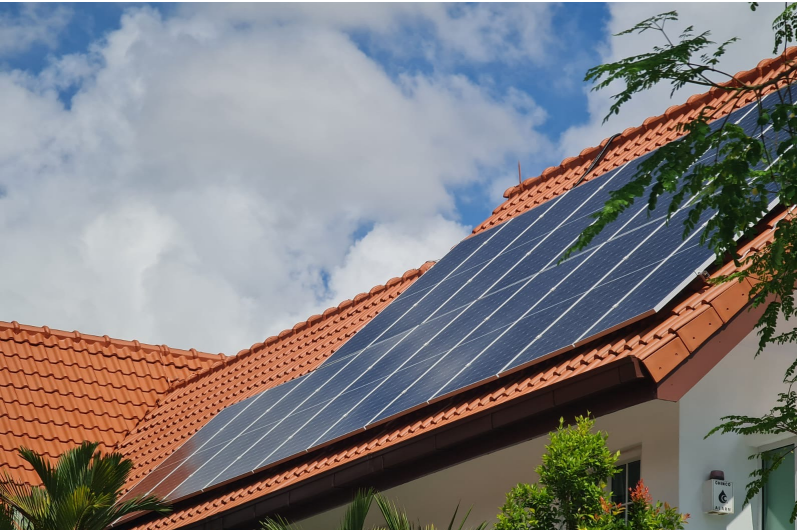
The single most common concern we hear from Singapore homeowners before installation is simple: "Will you be drilling into my roof?"
It's a fair question. Your roof is one of the most critical elements of your home, and the idea of a team of installers making penetrations into it, especially on an older tile roof, is understandably worrying.
The short answer is: yes, there are anchor points fixed into the roof structure, but the system is specifically engineered to remain completely watertight. Here's exactly how it works.
The Tile Roof Bracket System
For Singapore's most common residential roof type, the clay or concrete tile roof, the standard mounting approach uses a tile hook system rather than drilling directly through tiles.
The mounting hardware we use consists of three main components:
The tile hook (SF-RF-06): A purpose-built stainless steel bracket that slides underneath individual roof tiles and hooks onto the roof batten beneath. The tile above it is lifted, the hook is positioned, and the tile is replaced on top. No tile is cut or permanently removed.
The aluminium rail: An extruded aluminium rail in anodised AL6005-T5 grade runs horizontally across the roof, bolted to the tile hooks at regular intervals. This is the backbone of the system, it distributes the load of the panels across multiple attachment points rather than concentrating stress on any single spot.
End clamps and mid clamps: These secure the panels to the rail, clamping onto the panel frame. The Anodised AL6005-T5 aluminium is the same grade used in marine and architectural applications, highly resistant to Singapore's humidity, salt air, and UV exposure.
The stainless steel components are SUS304 grade, which offers excellent corrosion resistance and is standard for outdoor structural applications in tropical climates.
How Waterproofing Is Maintained
The tile hook penetration point is sealed with EPDM rubber gaskets and flashing tape before the tile is replaced. EPDM is a synthetic rubber that remains flexible across a wide temperature range, important in Singapore's climate, where roof surface temperatures can exceed 70°C in direct sun.
When the tile is replaced over the hook, it sits flush and the waterproofing barrier is fully restored. Water that runs down the roof surface follows the same path it always did, over and between the tiles, and never reaches the penetration point.
This is why the system carries a dedicated 2-year waterproofing warranty in addition to the 10-year product warranty on the mounting structure itself. If any water ingress were to occur at an anchor point within that period, it is remediated at no cost.
DC Cable Routing
The cables that run from the panels down to the inverter are an often-overlooked part of the installation. We use DC solar cables with tinned copper conductors rated to Class 5 of the IEC60228 standard, with XLPE (cross-linked polyethylene) insulation.
XLPE is specifically chosen for outdoor solar applications because it maintains its insulating properties under prolonged UV exposure and high temperatures, conditions that would degrade ordinary PVC insulation over time. These cables also carry a 10-year product warranty.
Cable runs are typically routed along the rail system and then down the interior of the roof cavity where possible, emerging at the inverter location through a sealed conduit penetration. No cables are left exposed on the exterior of the home.
The Inverter and DB Box Connection
The solar inverter, in our installations, a Sungrow unit, is typically mounted on an exterior wall in a sheltered location near the distribution board. The connection from the inverter into your DB box is made by a licensed electrical worker (LEW), which is a regulatory requirement in Singapore under the Energy Market Authority framework.
This LEW submission is handled entirely by us, along with the SP Group application for grid connection and ECIS metering. You do not need to engage a separate electrician or manage any regulatory paperwork.
What the Finished Installation Looks Like
Once complete, the panels sit cleanly on the rail system with uniform spacing. From ground level, the profile is low, typically 30–50mm above the tile surface, which minimises wind loading and preserves the visual character of the roof.
The rail and clamp system in anodised silver aluminium has a neutral appearance that reads as architectural rather than industrial. On dark or terracotta tile roofs in particular, the contrast between the dark panels and the roof is visually cohesive.
We've completed installations across Singapore from Branksome Road to Bukit Timah, Westwood Crescent to Sommerville Road. In every case, the goal is an installation that is structurally sound, watertight, and worth looking at.
The Warranty Summary
- Mounting structure (rails, hooks, clamps): 10-year product warranty
- DC solar cable: 10-year product warranty
- Waterproofing at penetration points: 2-year waterproofing warranty
- Workmanship (labour and installation): 5-year workmanship warranty
- Solar panels: 25-year product warranty, 30-year linear power warranty
- Inverter: 10-year product warranty
Ready to get your own solar system?
Want to see exactly how a system would be laid out on your roof? Book a free site survey and we'll prepare a custom roof design, no commitment required.
Get a free site survey